
Death of SaaS
Everyone’s saying SaaS is dying. It isn’t; it’s about to metamorphose. What that means for your tech budget depends on where you sit.
Ancient History
The key innovation of Software as a Service (SaaS) was a new model for software distribution. A brief-ish history that you’re welcome to skip…
- IBM Mainframes originally used paper punch cards to load software. Do not fold, spindle, or mutilate. Later, reel-to-reel magnetic tape replaced paper. Business users rarely interacted directly, but instead were delivered printed output with perforated pages.
- Mid-range systems such as AS/400 and HP-3000 did away with punch cards, but magnetic tape still ruled. Software updates arrived in padded envelopes, and only operators saw them. Clerical staff might have dumb terminals, but little more. Managers and above still worked with paper.
- As PCs became commonplace, the media used to distribute software changed rapidly from cassette tape, to 8” floppies, then 5.25”, and finally 3.5”. Managers started using PCs, but still relied heavily on paper for reporting and decision-making.
- As client-server took over, much of the business software was installed on the server, and users ran it via LAN. Updates arrived via CD, and for single-machine use mysteriously loaded in the pop-out cup holder. Paperless was a distant dream for all but a few early adopters. Besides, faxing your screen is silly.
SaaS Revolution
SaaS changed the game. Accessible from anywhere, no infrastructure required, only a working connection. Updates daily, hourly, whatever was required. Move fast and break things. Printers and fax machines were for luddites.
The pioneer was Salesforce, and they’re still the largest pure SaaS company. By the 2010s, “SaaS” was part of standard business vocabulary. Startups in the space were exploding, and that’s continued as more and more business processes move online.
AI Metamorphosis AKA SaaSpocalypse
Agentic AI is seen as a threat to SaaS hegemony, and it is — and it isn’t. Come again?
SaaS companies thrive by delivering a low-friction experience backed by solid domain knowledge. As more and more code is written by AI models, the effects will vary by customer tier.
Enterprise
Expect serious disruption. Companies in this space have the budget to create bespoke software at a rate never before seen. Enterprise SaaS isn’t dead, but the domain knowledge of the provider has to outweigh the implementation friction of their solution.
There is a big difference between bespoke systems streamlined for your specific processes versus SaaS in a utility role. Writing your own sales order process might be justified, but even the largest companies won’t be eager to reinvent email.
Many will choose to create swarms of AI agents that bridge the gap between “legacy” systems and modern collaboration platforms such as Slack or Microsoft Teams.
Note: Offering Model Context Protocol (MCP) integration will be table stakes for SaaS providers. I want to stay out of the weeds, but MCP is essentially an abstraction layer that allows AI agents to interact directly with an external system.
SMB
The disruption will be less. While companies may find it easy to create custom solutions, infrastructure and maintenance/upkeep continue to be real costs. Vibe coding your way to a tool that works wonderfully for your current process is easy. Having the discipline to apply security patches as the libraries you’re using are discovered to have vulnerabilities is not. Zombie projects are a real risk. And it remains to be seen how well homegrown solutions scale as the company grows. More likely is the use of MCPs to create custom wrappers around existing SaaS solutions.
Individual
Customers whose needs are slightly different than the mainstream will have the option to roll their own. They’ve always had that option, but it’s never been as easy as it is now. Sophisticated users are creating custom interfaces for any number of external services. And some have embraced an open source framework called OpenClaw to create their own personal assistant! I named mine Pepper…
Implications for SaaS
SaaS will survive. Existing software holds significant value for clients who don’t already have their own dev teams and/or domain knowledge. And it simply isn’t worth the lift to replicate a tool that’s not specific to your business model. SaaS that isn’t industry-specific should continue relatively unscathed if it’s low friction.
The most visible effect will be competition. Competitors will rise with relatively little capital, creating a long tail of startups who see themselves as the next Slack. Some of them will be so niche that they serve only a handful of customers. Most of them won’t cross the chasm.
The more interesting effect is extension. Clients who can afford to hire or outsource to even one engineer will find ways to build a private ecosystem around their SaaS tools. There will be an explosion of bespoke software and workflows that we’ll implement to get work done in more efficient ways. Or at least ways that seemed like a good idea at the time. Eventually the best ideas will be incorporated into the mainstream SaaS offerings, raising the baseline of what is possible and expected.
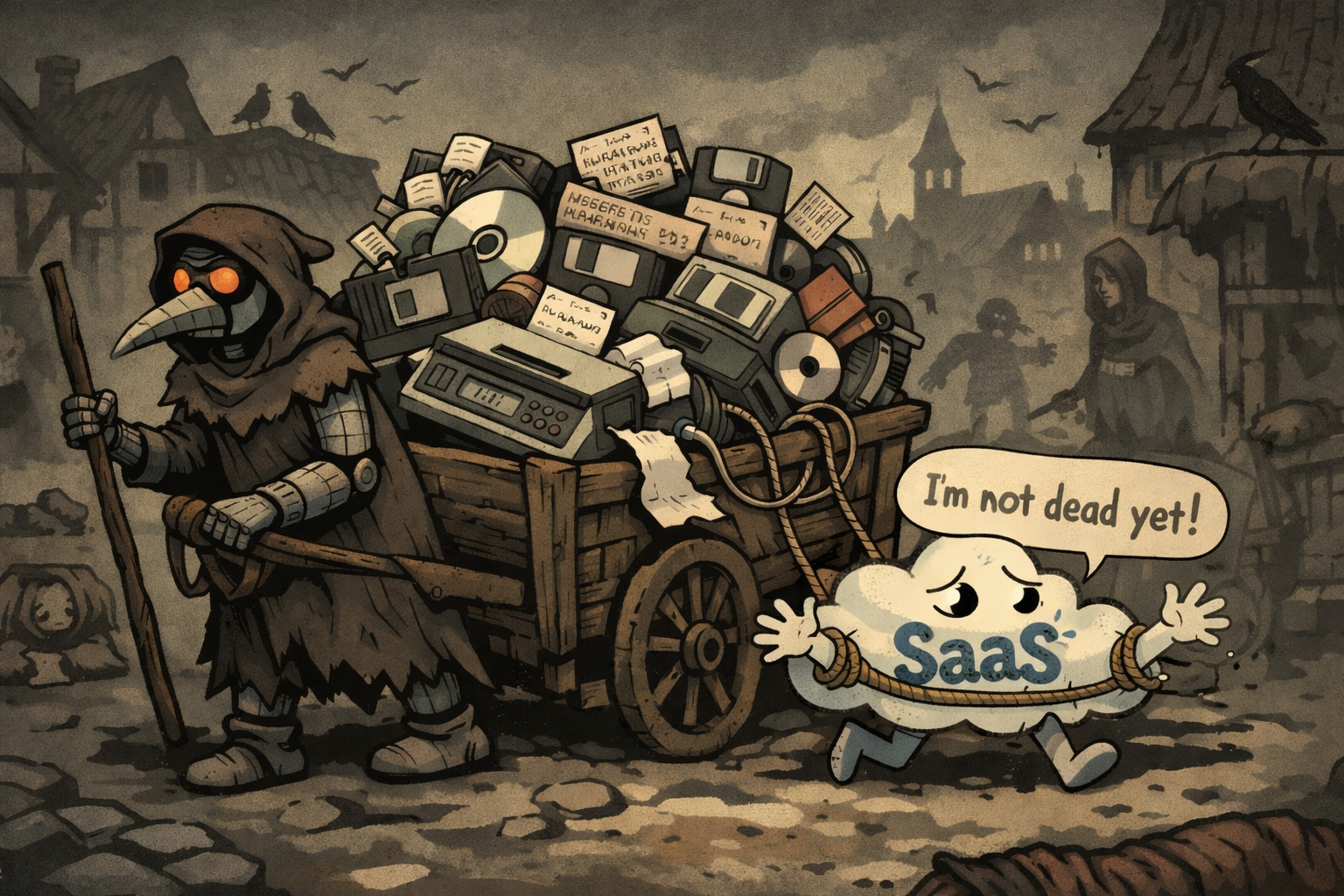
SaaS isn’t going on the cart. But what emerges from the cocoon won’t look much like what went in.
Join the Conversation on LinkedIn